My Journey: From Intern to Full-Time
My journey with Glints started with the COMPFEST 2024 AI Innovation Challenge. The competition was sponsored by Glints, and one of the outcomes for selected winners was the opportunity to intern there. The theme was centered around job portals, so the problem space was already aligned with what Glints is working on.
I joined as a contestant, and my team built a gamified job portal that included both employer and candidate sides. The idea was to make job searching and hiring more engaging by adding gamification elements, while keeping the core functionality practical. We focused on how users interact with the platform, not just the features themselves. I believe this approach was one of the main reasons why our solution stood out, and we ended up winning the competition. After that, I got the chance to go through the interview process for an internship role.
When I first joined as an intern, I mostly worked on bug fixes and small features. The focus at that time was on understanding the codebase and getting used to the workflow. Most tasks were clearly defined, so it was mainly execution.
This was different from my earlier tasks because the scope was larger and the responsibility was on me to make sure the tools worked properly and were usable.
By the end of the internship, I had handled both small-scoped tasks and a few that required more ownership. I think this showed that I could take responsibility for a complete feature, which led to the full-time offer.
Meaningful Projects & Contributions
The most meaningful contributions I made during my internship were two internal tools that I handled end-to-end — Job Quality Issue automatic flagging and the Fraud Case Review system. Both were used by the ops team and were directly related to improving job quality and platform trust.
For the Job Quality Issue flagging system, the goal was to help the ops team identify job listings that needed review. The system uses signals from other internal services, including salary benchmarks and job category recommendations. For salary, the system compares the listed value with expected ranges for the same role and location, based on data provided by another team. For the job category, I used a recommender system to generate a suggested category from the job title, then compared it with the existing category to detect mismatches.
My responsibility was to integrate these signals and make the output usable. Instead of just generating raw flags, I focused on how the results are structured so the ops team can review and prioritize them efficiently.
For the Fraud Case Review tool, the focus was on helping the ops team handle potential fraud cases more efficiently. Fraud signals can come from multiple sources — chat messages, job descriptions, and reports from candidates. I built a dashboard that consolidates this information and highlights cases that have a higher tendency for scam behavior, including automatically flagged chats.
This made it easier for reviewers to focus on higher-risk cases without manually checking everything. As a result, the team was able to reduce the number of fraudulent or suspicious job listings more effectively.
Both projects were directly used in daily operations. I think the impact came from making existing processes more efficient and structured, rather than introducing something completely new.
Growth & Advice for Future Interns
Looking back, the biggest change during my internship was getting used to handling work end-to-end. At the beginning, I was focused on completing assigned tasks correctly. But over time, especially when working on the Job Quality Issue flagging and Fraud Case Review tools, I had to take responsibility for the full flow, not just implementation.
This means making sure the feature works properly, handles different cases, and can actually be used in operations. It also requires thinking beyond code — how output is consumed and whether it helps the ops team do their work more efficiently. That experience pushed me to be more careful with decisions and more aware of the impact of what I build.
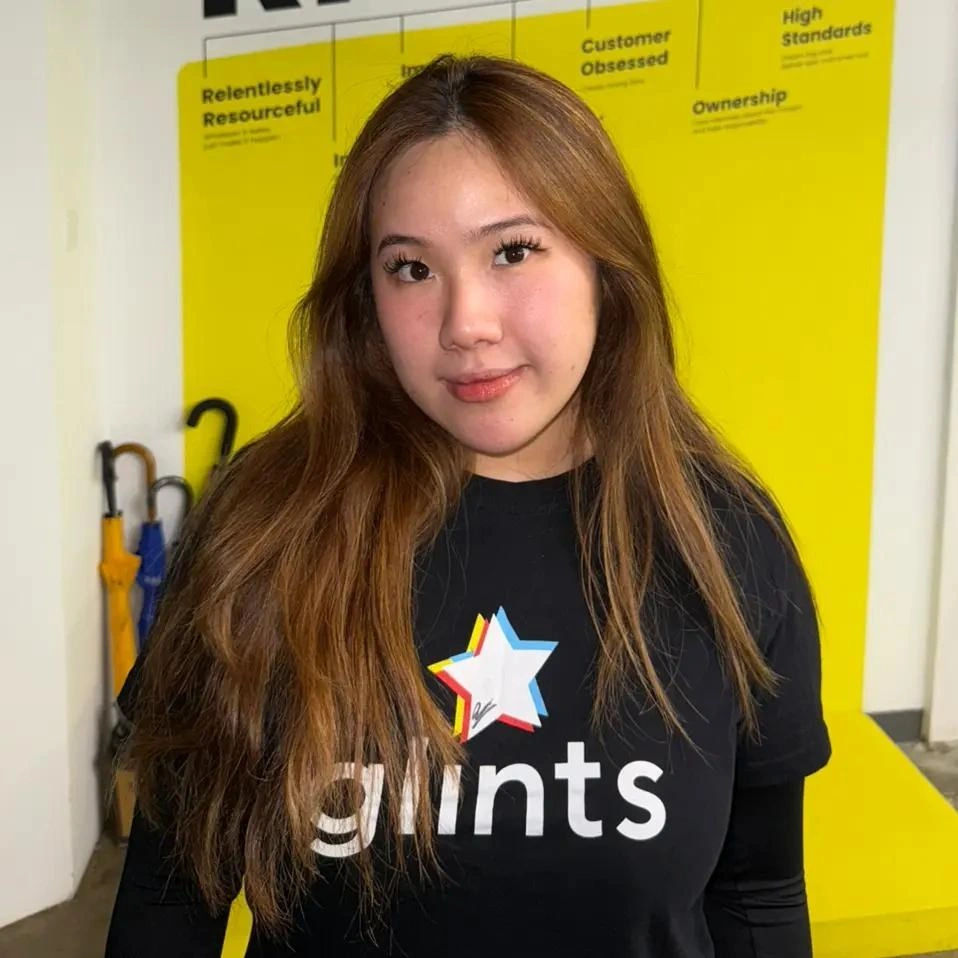
One thing that helped me during this process was aligning with the working culture in Glints, especially RIIBCOH. "Ownership" was directly relevant when handling projects end-to-end. "Customer Obsessed" applied when thinking about how the ops team would use the tools in practice. "High Standard" also mattered, because the tools were used repeatedly, so they needed to be reliable, not just functional.
For interns who want to convert to full-time roles, my advice is not to stop at completing tasks. Try to understand how your work is used and whether it actually solves the intended problem. If you have the opportunity, take responsibility for a feature from start to finish, even if it is not perfect.
It is also important to be proactive. If something is unclear, ask. If you see a gap, try to address it. At the same time, keep your work aligned with the team's standards and expectations.
What Makes Glints Different
What makes Glints a place where interns can grow into full-time roles is how quickly interns are exposed to real work that is actually used in operations. Interns are not limited to isolated or low-impact tasks for a long period. After the initial onboarding phase, there are opportunities to work on problems that are part of the main workflow.
In my case, I started with bug fixes and small features, but later I was able to work on internal tools that were used by the ops team on a daily basis. This kind of exposure makes a difference, because it forces you to think about reliability and usability, not just implementation.
Another factor is the level of ownership given to interns. When working on larger tasks, the expectation is not only to deliver the code, but also to make sure the feature works properly as part of the overall system. This includes handling edge cases and making sure the output can be used without causing additional issues.
In addition, the working culture, including RIIBCOH, is reflected in how tasks are approached. Ownership and high standards are not just stated values, but are expected in day-to-day work. This creates a consistent expectation that helps interns understand what is required to perform at a full-time level.
Overall, interns can grow because they are given real responsibility, clear expectations, and direct exposure to how their work impacts the product.